
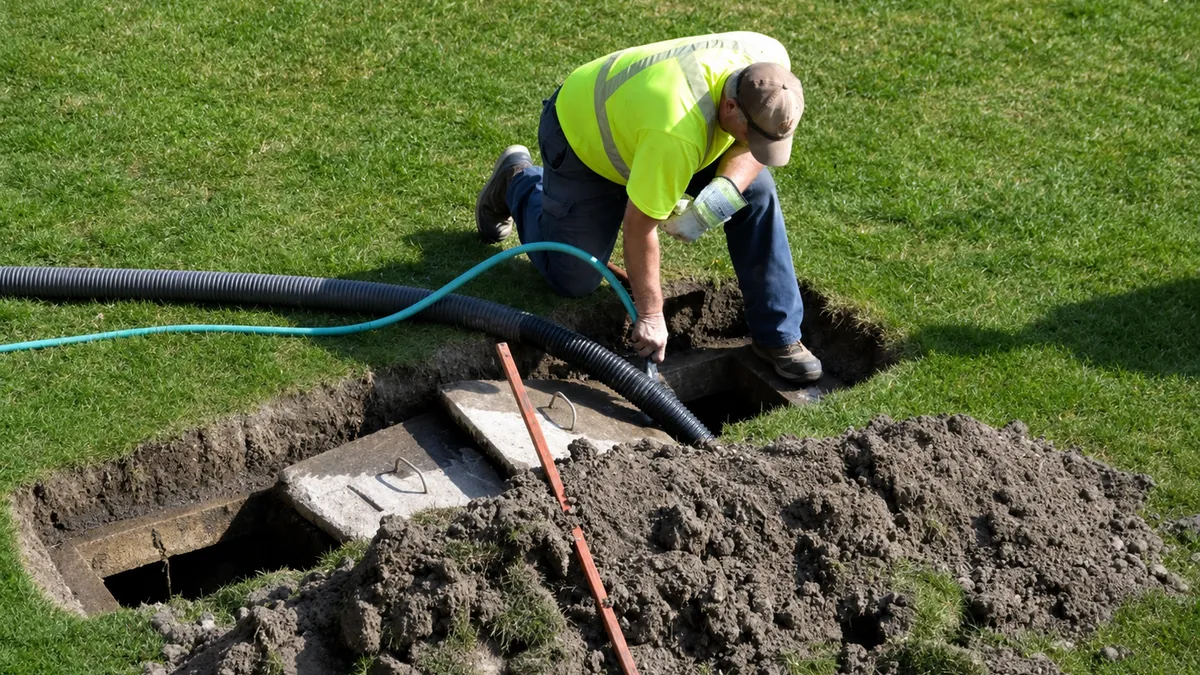
Who is allowed to do a septic tank repair in Florida?
A state-registered contractor, and the homeowner on their own house. Section 381.0065(4), Florida Statutes, states that a person "may not contract to construct, modify, alter, repair, service, abandon, or maintain any portion of an onsite sewage treatment and disposal system without being registered under part III of chapter 489". The same subsection carves out one exception: a property owner who personally performs repairs on a system serving their own owner-occupied single-family residence is exempt from the registration requirement, "but is subject to all permitting requirements". So doing it yourself is legal on your own home and it does not get you out of the permit.
You can check any contractor against the state register free, in about two minutes, using the Florida Department of Environmental Protection business authorization search and the individual certification search linked at the bottom of this page. Ask for the registration number and the exact name it is held under before you search, because trade names and registered legal names often differ. The septic tank installers page walks through that check step by step.
Does a septic tank repair need a permit in Marion County?
Yes. Section 381.0065(4), Florida Statutes, says a person "may not construct, repair, modify, abandon, or operate an onsite sewage treatment and disposal system without first obtaining a permit approved by the department", and "a repair permit is valid for 90 days after the date of issuance". In that statute "department" means the Florida Department of Environmental Protection, which reports that it expanded OSTDS permitting into Marion County in July 2025. The registered contractor normally files the application and schedules the work inside the 90-day window. Our Marion County permit guide covers the process and the current fee picture.
The septic tank repairs Marion County systems actually need
Most trouble traces to a short list of parts, and each of them is a repairable, permitted job with a defined cost. Tank baffles that rot or break. Cracked lids and risers. A clogged or tilted distribution box. A failed effluent pump or float switch on systems that need one. Roots in a line. A crushed pipe between the house and the tank. Fixing the failed part early protects the expensive parts downstream, which is the whole argument for diagnosing before replacing.
Septic tank problems: what does each symptom mean?
Start with the symptom, because it narrows where the fault sits before anyone digs. EPA lists the signs of a failing system as water and sewage backing up into the home's plumbing, tubs, showers and sinks draining very slowly, gurgling in the plumbing, standing water or damp spots near or over the tank or drainfield, sewage odors around the tank or drainfield, and bright green spongy grass over the tank or drainfield even during dry weather.
- Slow drains and gurgling. Points at the line, the tank, or the field.
- Odours near the tank. Often lids or baffles. EPA also notes an odor can come from a blocked roof or vent pipe, which is a normal part of the system, and says the exact cause of an odor cannot be diagnosed remotely.
- An alarm. The pump or the floats on a system that has them.
- Soggy or lush ground over the field. Points at the field itself. EPA treats soft, wet or spongy soil there, absent significant rainfall, as a good indication of system failure.
Our failure-signs guide walks through each symptom in more detail.
Septic tank repair or drain field replacement: which do you need?
The honest answer comes from a diagnosis, not a sales pitch. A component failure gets a component repair. When the drainfield itself is spent, patching around it wastes money and the durable fix is a full drain field repair and replacement. A tank that has gone years without pumping is often the root cause, which is why septic tank service on EPA's three-to-five-year cycle is the cheapest protection a system gets.
What shapes a septic system repair in Marion County?
Two local factors decide how big a repair turns out to be. The wet-season high water table stresses marginal drainfields, so a fault that would be a small fix elsewhere can expose a field that is already at the end of its life. And inside the combined Silver and Rainbow springs BMAP, a replacement triggered by a failed repair may need to be an advanced nutrient-reducing system, which changes the budget and the permit.
Planned septic repair, not emergency response
This page covers planned diagnosis and repair. It is not an emergency line. If sewage is backing up into your home right now, contact a local septic company directly. EPA's advice in that situation is to avoid contact with the sewage, because it may contain harmful pathogens.
How it works
Describe the symptom using the form below. A registered local contractor diagnoses the system on site and gives you a free, no-obligation quote for the septic tank repair it actually needs.
Sources and where to verify
- Section 381.0065, Florida Statutes (OSTDS permits and registration)
- Section 381.0066, Florida Statutes (OSTDS fees)
- US EPA: Resolving septic system malfunctions
- US EPA: How to care for your septic system
- FDEP septic business authorization search
- FDEP individual septic certification search
- FDEP Onsite Sewage Program
- FDEP OSTDS Phase I transition update (Marion County brought online July 2025)
- UF/IFAS: Handbook of Florida Water Regulation (OSTDS, FE614)
Local details last reviewed August 16, 2026.